

Skip Navigation
Edvisors Star Logo
Edvisors Logo
  • Scholarships
    • COLLEGE GRANTS
    • COLLEGE SCHOLARSHIPS
    • EMPLOYER
    • MILITARY

    featured articles

    • What's the difference between scholarships and grants?
    • Graduate Fellowships
    • View All Articles >

    featured articles

    • How to Find Scholarships
    • Top Tips for Winning Scholarships for College
    • Apply for Free Scholarships for College
    • Most Popular Scholarships for College Students in 2026
    • View All Articles >

    featured articles

    • What is Federal Work Study Program?
    • Employer Tuition Assistance Programs: How Do They Work?
    • View All Articles >

    featured articles

    • GI Bill
    • Military Service Academies
    • ROTC Scholarships
    • View All Articles >
  • Plan for College
    • CAREERS
    • COLLEGE ADMISSIONS
    • FAFSA
    • SCHOLARSHIPS
    • PAYING FOR COLLEGE
    • STUDENT LIFE BLOG

    featured articles

    • Best Job Search Sites March 2026
    • Resumes That Get Noticed
    • High Paying Careers
    • STEM Careers
    • View All Articles >

    featured articles

    • Determining College Academic Fit: Reach, Match and Safety Schools
    • Need-Blind Admissions
    • How Long is a College Essay
    • When are College Applications Due
    • How to Write a Good College Essay
    • View All Articles >

    featured articles

    • Filing the FAFSA 2026-2027: A Simple Guide for Students
    • FAFSA® Deadlines for 2026-2027
    • FAFSA FAQ - Your FAFSA Questions Answered
    • View All Articles >

    featured articles

    • Most Popular Scholarships for College Students in 2026
    • Apply for Free Scholarships for College
    • College Scholarships for Kids
    • Most Prestigious Undergraduate Scholarships
    • Las mejores becas para estudiantes hispanos y latinos
    • View All Articles >

    featured articles

    • How to Pay for College
    • Tuition Payment Plans
    • Pros and Cons: Borrowing From My 401K to Pay for College
    • Paying College Tuition with a Credit Card
    • Best Ways to Pay for College Without Financial Aid
    • View All Articles >

    featured articles

    • Financial Aid Disbursement: When and How You Will Get It
    • Should I Pay Off My Student Loans Right Now
    • How to Minimize Student Loan Debt
    • View All Articles >
  • Student Loans
    • FAFSA
    • PRIVATE STUDENT LOANS
    • FEDERAL STUDENT LOANS
    • REPAY STUDENT LOANS
    • LENDER REVIEWS

    featured articles

    • Filing the FAFSA 2026-2027: A Simple Guide for Students
    • FAFSA FAQ - Your FAFSA Questions Answered
    • FAFSA® Deadlines for 2026-2027
    • FAFSA® School Codes
    • FAFSA 2023-2024 Guide & Resources
    • View All Articles >

    featured articles

    • Best Private Student Loans for March 2026
    • Student Loan Comparison: Federal Loans vs Private Loans
    • Parent PLUS Loans vs Private Student Loans
    • How Does Interest on Student Loans Work?
    • Private Student Loan Cosigner: Everything you Need to Know
    • View All Articles >

    featured articles

    • Filing the FAFSA 2026-2027: A Simple Guide for Students
    • FAFSA FAQ - Your FAFSA Questions Answered
    • The complete guide to federal undergraduate student loans
    • What are Federal Parent PLUS Loans and How to Apply
    • Financial Aid for Graduate School
    • Compare Subsidized and Unsubsidized Student Loans
    • View All Articles >

    featured articles

    • Best Student Loan Refinance Companies for March 2026
    • Federal Student Loan Repayment Plans
    • Student Loan Forgiveness: How to Get Student Loans Forgiven
    • Repayment Plans for Private Student Loans
    • Should You Refinance Federal Student Loans?
    • Parent PLUS Loan Forgiveness
    • View All Articles >

    featured articles

    • Sallie Mae Student Loan Review
    • College Ave Student Loan Review
    • SoFi Student Loan Review
    • Ascent Student Loan Review
    • View All Articles >
  • Money Management
    • BANKING
    • BUDGETING
    • SAVING
    • DEBT MANAGEMENT
    • CREDIT
    • INVESTING
    • RISK MANAGEMENT

    featured articles

    • What is Online Banking
    • Student Checking Accounts
    • Debit Cards with Rewards
    • View All Articles >

    featured articles

    • Best Budgeting Apps March 2026
    • Budgeting Tips
    • Budgeting for Beginners
    • View All Articles >

    featured articles

    • Financial Goals
    • How to Save Money as a College Student
    • What is an Emergency Fund
    • View All Articles >

    featured articles

    • How to Pay Off Debt
    • Debt Relief
    • What is a Debt Management Plan
    • View All Articles >

    featured articles

    • How to Check Your Credit Score
    • Best Credit Building Apps March 2026
    • What is Credit?
    • View All Articles >

    featured articles

    • Investing for Beginners
    • Best Investment Apps March 2026
    • Understanding the Stock Market
    • View All Articles >

    featured articles

    • What is Risk Management
    • How to Prevent Identity Theft
    • What is Insurance
    • View All Articles >
  • Student LIFE Blog
  • Scholarships
  • Plan for College
  • Student Loans
  • Money Management
  • Student LIFE Blog
Search Box Form
Advertiser Disclosure
×

Edvisors (“Edvisors Network, Inc.”) provides independent advertising-supported platforms for consumers to search compare and apply for private student loans. Loan offers from participating lenders that appear on our websites are not affiliated with any college and/or universities, and there are no colleges and/or universities which endorse Edvisors’ products or services. Lender search results do not constitute an official college preferred lender list. Edvisors receives compensation from lenders that appear on this site. This compensation may impact the placement of where lenders appear on this site, for example, the order in which the lenders appear when included in a list. Not all lenders participate in our sites and lenders that do participate may not offer loans to every school.

Edvisors is not a lender and makes no representations or warranties about your eligibility for a particular loan or financial aid. Lenders are solely responsible for any and all credit decisions, loan approval and rates, terms and other costs of the loan offered and may vary based upon the lender you select. Please check with your school or lender directly for information related to your personal eligibility.

Edvisors has endeavored to provide accurate information. However, the results provided by lenders are for illustrative purposes only and accuracy is not guaranteed, as such, Edvisors assumes no responsibility for errors or omission in the information provided.

Advertiser Disclosure
×

Edvisors (“Edvisors Network, Inc.”) provides independent advertising-supported websites. The Edvisors websites’ goal is to provide relevant and helpful content and comparison tools to better assist consumers to search and compare financial products or services. The offers, products or services listed on our websites are from third-party advertisers or companies from which Edvisors receives compensation. This compensation may impact the placement of where products or advertisements appear on this site, for example, the order in which the products appear when included in a list. Not all providers participate in our sites and providers that do participate may not offer the entire suite of applicable credit cards or financial products provided by the provider or available in the marketplace.

Edvisors is not a lender and makes no representations or warranties about your eligibility for a particular credit card, financial product, or service. The third-party providers are solely responsible for any and all credit decisions, loan approval and rates. Terms and other costs of the credit card or financial product may vary based upon the provider you select. Not all consumers will qualify for the advertised rates and terms.

Edvisors does not purport to offer financial advice related to the purchase or sale of financial products or services. We are not an investment, brokerage, or financial advisory service. Information provided with respect to financial products and services are solely intended for educational purposes. In addition, we recognize each person may have unique and individualized financial needs and we recommend and encourage you to seek the expert advice of qualified professionals regarding your specific financial needs.

Edvisors has endeavored to provide accurate, up to date information. However, because credit card offers and financial products change frequently and do not originate with us, we recommend you check the offering provider for complete terms and conditions, rates, costs, and other fees. Providers do not commission, review or approve the information available on the site. Information provided on the site is for illustrative purposes only and accuracy is not guaranteed, as such, Edvisors assumes no responsibility for errors or omission in the information provided.

Except as expressly set forth in our Terms of Use, all representations and warranties regarding the information presented on our websites are disclaimed.

×
Get Your Free Guide to Filing the FAFSA Today!

Thank you for your interest in Edvisors' 2020-2021 Guide to Filing the FAFSA.

Please complete the form below to access your free copy.

Thank you! Click here to download your free FAFSA Guide.

I am a:

×
College knowledge starts here!

Enter your email below to receive your Student Loan Handbook from Edvisors.

Please check your email for the Student Loan Handbook.

After Navigation
Home » Student Loans » Federal Student Loans » Student Loan Borrowing Limits in 2026
  • Contents
  • Is There a Limit On Student Loans?
  • How Student Loan Limits are Calculated
  • Private Student Loan Limits
  • Federal Student Loan Limits
  • Direct Subsidized and Unsubsidized Loan Limits
  • Direct Unsubsidized Loan Limits for Health Profession Students
  • Other Direct Loan Limits
  • If Parents Refuse to File the FAFSA
  • Increased Direct Unsubsidized Loan Limits for Dependent Undergraduate Students
  • Prorated Annual Loan Limits for Undergraduate Students
  • Direct PLUS Loan Limits
  • Direct Consolidation Loan Limits
  • Recommendations
  • What to Read Next

Student Loan Borrowing Limits in 2026?

Photo of Elaine Rubin
By Elaine Rubin
Updated on April 3, 2025
Important Note:  Changes are coming to Direct PLUS loans beginning July 1, 2026.  The GRAD Plus program will be eliminated and loan limits are being set for Parent PLUS loans.  There are legacy provisions for existing students and/or parents already borrowing from either one of these programs.  

Summary: Each student loan has borrowing limits. Annual limits determine the amount you can borrow for a single academic year, while aggregate limits set a maximum on your total borrowing throughout the loan program. Furthermore, the loan amount can’t go over your school’s official cost of attendance once other financial aid is deducted.

Key Takeaways about Student Loan Limits
 
  • Federal student loan limits are determined by the type of loan, the student’s dependency status, and the student’s grade level, and past borrowing history.
  • Dependent undergraduates may borrow up to $31,000 in federal student loans.
  • Independent undergraduates may borrow up to $57,500 in federal student loans.
  • Graduate or professional students may borrow up to $138,500 in federal student loans, and certain health profession students may borrow up to $224,000.

Is There a Limit On Student Loans?

Yes. Most student loans have several types of limits on the amount you can borrow.

Annual Student Loan Limits

An annual limit specifies the maximum amount you can borrow in a single academic year in each loan program for which you are eligible. 

Aggregate Student Loan Limits

An aggregate limit, sometimes called a cumulative limit, specifies the total amount you are allowed to borrow through each loan program. One of the most common loan programs, the federal Direct Stafford Loan program. 

Cost of Attendance Loan Limits

Your school's financial aid office cannot provide financial aid that exceeds your cost of attendance, which includes tuition, fees, housing, meals, transportation, and more. Financial aid is usually awarded in the order of scholarships, grants, work-study aid, and then student loans as needed. The cost of attendance (COA) dictates the maximum total cost after deducting other forms of financial assistance you may receive. This COA limit complements or replaces the annual loan limit to ensure that all aid, including student loans, stays within your school's determined budget for attendance.

Remember, making informed decisions about how to finance your education can significantly impact your financial well-being long after graduation. 

How Student Loan Limits are Calculated

When you take out a student loan, both the annual and aggregate loan limits are applied to the loan amount. Each type of loan limit represents a restriction on the amount you can borrow.

Sometimes, you may want to borrow an amount that satisfies the annual limit, but you will qualify for a lower amount because your total debt would exceed the aggregate loan limit. You will then be restricted to the lower loan amount.

For example:

The Direct Unsubsidized Loan has annual limits for dependent undergraduate students based on the student’s year in school. The 2025 - 2026 loan limits are:

  • $5,500 for freshmen
  • $6,500 for sophomores
  • $7,500 per year for juniors, seniors, and any additional undergraduate years of study

The Direct Unsubsidized Loan also has an aggregate loan limit of $31,000 for dependent undergraduate students.

Suppose a dependent undergraduate student in a 5-year engineering degree program borrows the annual maximum for each of the first four years, for a total of $27,000. During the student’s fifth year the annual limit would be $7,500. However, as the next table shows, the remaining aggregate loan eligibility is only $4,000 after the end of the fourth year. So, the student can’t borrow the $7,500 annual maximum as a fifth-year senior. Instead, this student can borrow no more than $4,000.

Student Loan Limits By College Year
Year Annual Limit Amount Borrowed Aggregate Debt Remaining Aggregate Loan Eligibility
First Year (Freshman) $5,500 $5,500 $5,500 $25,500
Second Year (Sophomore) $6,500 $6,500 $12,000 $19,000
Third Year (Junior) $7,500 $7,500 $19,500 $11,500
Fourth Year (Senior) $7,500 $7,500 $27,000 $4,000
Fifth Year (Senior) $7,500 $4,000 $31,000 $0

Private Student Loan Limits

Private student loans come with an annual limit based on the cost of attendance minus other financial aid, such as federal student loans. Undergraduates usually have aggregate loan limits from $75,000 to $120,000, while graduate and professional students may qualify for higher limits. Remember, these limits cover all student loan debt - both federal and private loans combined.

Instantly Compare Lenders

Medical and dental residency and relocation loans and law bar study loans typically have annual loan limits that are 50% lower than the annual loan limits for students who are currently enrolled in school.

Even though you are working with a private student loan lender, your school will still certify the total amount you are able to borrow. Your school will let your lender know if adjustments needs to be made in order to ensure you are not offered financial aid (which includes student loans) in excess of your cost of attendance minus other aid received. 

Ascent's private student loan gives students more opportunities to qualify for a loan with benefits that put students first, like 1% Cash Back at graduation and more… Learn More About Ascent

Federal Student Loan Limits

A federal student loan limit isn’t the amount you will be able to borrow, it’s the maximum the school can approve you to borrow. Your school might give you less than the loan limit.

The annual and aggregate borrowing limits on federal student loans vary based on several factors:

  • Loan Program (Direct Subsidized Loan, Direct Unsubsidized Loan, or Direct PLUS Loan)
  • Dependency Status (Dependent or Independent)
  • Year in School or Grade Level (Freshman, Sophomore, Junior, Senior, or Graduate Student)
  • Health Professional Student

If your grade level changes in the middle of the academic year, you may qualify for higher annual loan limits. You would then be eligible to borrow the difference between the new annual loan limit and the amount you already borrowed during the same academic year.

Similar rules apply to transfer students. Transferring from one school to another does not reset the loan limits. This can get a little tricky is you are transferring in the middle of an academic year. Your school will essentially let you borrow the difference between your annual loan limit at the new school and the amount received at the previous school. All loans borrowed through a loan program (i.e., Direct Stafford Loans) will count towards your aggregate loan limit.  

Loan fees (which may be added to the loan balance) and capitalized interest do not count against the loan limits.

Direct Subsidized and Unsubsidized Loan Limits

Your school's financial aid office determines how much you will be able to borrow each year. This amount might be less than the annual loan limit.

When it comes to the Direct Stafford Loan program, it's important to remember there are two types of loans in the this loan program: Direct Subsidized Loans and Direct Unsubsidized loans. Although these loans are part of the same program, Direct Subsidized Loans have their own limits. 

Eligibility for Direct Subsidized Loans is based on demonstrated financial need, up to the annual and aggregate loan limits. (As of July 1, 2012, students attending graduate school or professional school are no longer eligible to borrow new Direct Subsidized Loans.)

One more thing to keep in mind, beyond annual and aggregate loan limits, there is a maximum eligibility period for you to receive Direct Subsidized Loans. For first-time borrowers whose first loan was obtained on or after July 1, 2013, there is a maximum eligibility period of time that you can receive Direct Subsidized loan funds. You are only able to receive Direct Subsidized loans for no more than 150% of the published length of your program.

For example, if you are enrolled in a four-year degree program, the maximum amount of time you can receive Direct Subsidized loan funds is 150% of four years, which is six years.

Eligibility for Direct Unsubsidized Loans does not depend on demonstrated financial need.

Aggregate loan limits, sometimes referred to as cumulative limits, may be refreshed by repaying the debt. So, if you have hit the aggregate loan limit, you will need to pay down your loan before you will be eligible to borrow more.

The aggregate loan limits for students attending graduate school or professional school students include any undergraduate federal student loan debt.

Borrowing Limits for Direct Subsidized and Unsubsidized Loans
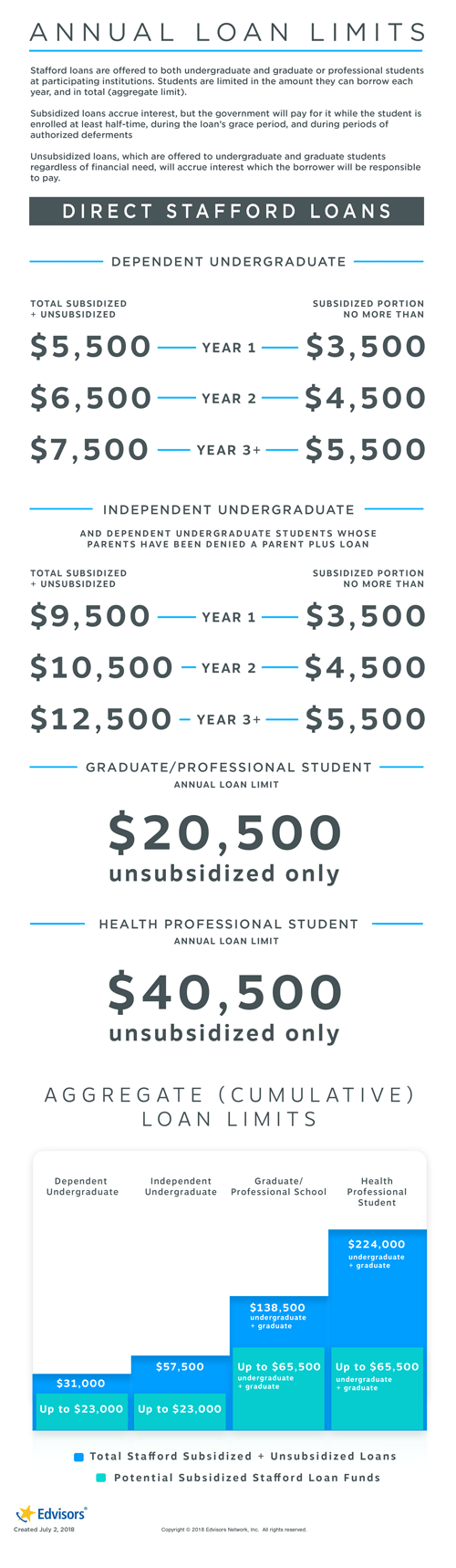
Direct Subsidized and Unsubsidized Loan Program Annual Loan Limits


Direct Unsubsidized Loan Limits for Health Profession Students

Health profession students, such as students enrolled in medical school, are eligible for higher Direct Loan limits.

There are two different levels of increased loan limits, depending on the area of study (see table). These limits are available only to health profession students enrolled at U.S. colleges and universities. Students enrolled at foreign institutions are not eligible.

Health Professions Loan Limits
Health Professions Programs Eligible for Higher
Direct Unsubsidized Loan Limits
Direct Unsubsidized Loan Limit
9-Month Academic Year
Direct Unsubsidized Loan Limit
12-Month Academic Year
  • Doctor of Allopathic Medicine
  • Doctor of Osteopathic Medicine
  • Doctor of Dentistry
  • Doctor of Veterinary Medicine
  • Doctor of Optometry
  • Doctor of Podiatric Medicine
  • Doctor of Naturopathic Medicine
  • Doctor of Naturopathy
$40,500 $47,167
  • Doctor of Pharmacy
  • Graduate in Public Health
  • Doctor of Chiropractic
  • Doctoral Degree in Clinical Psychology
  • Masters/Doctoral Degree in Health Administration
$33,000 $37,167

Some schools may also offer 10-month or 11-month academic programs, which would have different annual limits than those listed here. Check with your school’s financial aid office to get the limits for your program.

Other Direct Loan Limits

Additional Loan Funds for Preparatory Coursework

  • All students: Up to $2,625 for coursework required for enrollment in an undergraduate degree or certificate program
  • Bachelor’s degree recipients: Up to $5,500 for coursework required for enrollment in a graduate or professional degree or certificate program
  • Bachelor’s degree recipients: Up to $5,500 for state-required teacher certification coursework

These loan funds are limited to a period of 12 consecutive months. Any loans received for preparatory coursework will be counted towards your Direct Loan aggregate loan limits. 

If Parents Refuse to File the FAFSA

If the parents of a dependent undergraduate student decline to complete the FAFSA (Free Application for Federal Student Aid), the college's financial aid administrator may still permit the student to borrow additional Direct Unsubsidized Loans, even if the FAFSA is incomplete. Keep in mind that the student will not be eligible for the Direct Subsidized Loan, the Federal Pell Grant, or other types of federal student aid.

Increased Direct Unsubsidized Loan Limits for Dependent Undergraduate Students

There are times when a dependent student can become eligible for the same Direct Unsubsidized Loan limits as independent students:

  • Parents are denied eligibility for a Parent PLUS Loan
  • Other documented "exceptional circumstances," even if parents aren't denied eligibility for a Parent PLUS Loan

In some exceptional circumstances, college financial aid administrators may allow a dependent undergraduate student to borrow at the higher Direct Unsubsidized Loan limits available to independent students without requiring the parent to obtain a denial of a Parent PLUS Loan. For example, you would need to successfully qualify for a dependency override. 

College financial aid administrators aren't required to make the student eligible for the higher loan limits, even if exceptional circumstances exist.

Prorated Annual Loan Limits for Undergraduate Students

Annual loan limits for Direct Loans are prorated (adjusted) for undergraduate students who are enrolled in programs that are:

  • Shorter than one academic year; or
  • Remaining period of study is shorter than one academic year

For example, if an undergraduate student in a 4-year Bachelor’s degree program will be graduating at the end of the fall semester (halfway through the academic year), the student is eligible for half of the annual loan limit for seniors.

Half-time students are eligible for the same annual loan limits as full-time students.

Direct PLUS Loan Limits

The annual loan limit for the Direct PLUS Loan (Parent PLUS Loan or Grad PLUS Loan) is the annual cost of attendance minus other aid received during the enrollment period. There is no aggregate loan limit. The loan limits are the same for both parents of undergraduate students as well as graduate students.

Direct Consolidation Loan Limits

There are no limits on Direct Consolidation Loans (also known as Federal Consolidation Loans), other than the underlying limits on the loans included in the consolidation loan.

Recommendations

  1. File the FAFSA every year to maintain your eligibility for student aid.
  2. When you compare different types of student loans, make sure you understand both the annual and aggregate loan limits.
  3. If you are a dependent undergraduate student and your parents won’t qualify for a Parent PLUS Loan due to an adverse credit history, encourage them to apply anyway because a denial will make you eligible for the same Direct Loan limits as an independent student.
  4. If you’ve hit the annual and/or aggregate limits on federal loans, but you still need additional funds to complete your education, consider private student loans as a potential option.

What to Read Next

Best Private Student Loans for March 2026

Undergraduate Student Loans

Student Loans for College

Private Parent Student Loans

Parent PLUS Loans

Financial Aid for Graduate School


Email This Article
Fill out the form below to send a copy of this article to your email.
By clicking "Submit" I have read and agree to the Edvisors' Terms of Use and Privacy Policy. We strongly encourage you to read our Privacy Policy to understand how we use and share your information.
A copy of this article has been sent to your email.

Related Content

What are Federal Parent PLUS Loans and How to Apply?
Elaine Rubin
April 08, 2025
Learn how who is eligible to borrow a Parent PLUS Loan, what to consider, and how to apply.
Read Article
Financial Aid for Graduate School
Edvisors Network
April 03, 2025
First, start by filing the FAFSA to apply for federal student loans. There are thousands of scholarships and grants available for graduate students as well.
Read Article
Student Loans for Graduate School
Elaine Rubin
April 16, 2025
Graduate students can borrow federal and private student loans. Federal student loans include Direct Unsubsidized Loans and Grad PLUS Loans. Private student loans are also available and may offer more competitive rates.
Read Article
Subsidized vs Unsubsidized Student Loans
Elaine Rubin
December 04, 2024
The federal student loan program offers a variety of options. It can seem overwhelming, and tricky to navigate, but it doesn't have to be. Learn more about your options and compare the loans to find out which one is right for you.
Read Article
The Complete Guide to Federal Undergraduate Student Loans
Elaine Rubin
April 03, 2025
Get your federal undergraduate student loan questions answered with our complete guide!
Read Article
We care about your privacy

This website uses cookies to offer you the most relevant marketing and targeted advertisements which in some states may be considered a sale of your personal information. You may exercise your right to opt out by clicking on deny cookies. Please accept cookies for the optimal experience. You can withdraw or modify your consent for non-essential cookies at any time by visiting Cookie Settings page

This website uses cookies for targeted advertising which in some states may be considered a sale of your personal information. You may opt out by clicking on deny cookies. Please accept cookies for the optimal experience. You can change your consent for such cookies via the Cookie Settings page

Edvisors
  • About Us
  • Official Rules
  • Team
  • Testimonials
Resources
  • Blog
  • Newsletter
  • Video Resources
  • Financial Terms Glossary
  • Site Map
Media
  • Edvisors In the News
  • Press
Contact Us
  • Help
  • Student Aid FAQ
  • Directions
Legal
  • Terms of Use
  • Privacy
  • Consumer Health Privacy Notice
  • General Website Disclaimer
  • Accessibility Statement
  • Interest-Based Ads
  • Notice of Financial Incentive
  • Notice at Collection
  • Cookie Settings
  • Your Privacy Choices Your Privacy Choices Icon

Better Business Bureau logo

THE ENTITY MAINTAINING THIS WEBSITE IS A DATA BROKER UNDER TEXAS LAW. TO CONDUCT BUSINESS IN TEXAS, A DATA BROKER MUST REGISTER WITH THE TEXAS SECRETARY OF STATE (TEXAS SOS). INFORMATION ABOUT DATA BROKER REGISTRANTS IS AVAILABLE ON THE TEXAS SOS WEBSITE. YOU MAY BE ENTITLED TO STATE PRIVACY RIGHTS. YOU CAN REVIEW AND EXERCISE THOSE PRIVACY RIGHTS BY VISITING EDVISORS’ PRIVACY POLICY.

Edvisors provides expert advice on planning and paying for college. On Edvisors.com easily compare student loan lenders, learn how to apply for financial aid, and discover scholarships. Learn about federal and private student loans for students and parents, how and when to apply to college, and more!

Edvisors (“Edvisors Network, Inc.”) provides independent advertising-supported platforms for consumers to search compare and apply for private student loans. Loan offers from participating lenders that appear on our websites are not affiliated with any college and/or universities, and there are no colleges and/or universities which endorse Edvisors’ products or services. Lender search results do not constitute an official college preferred lender list. Edvisors receives compensation from lenders that appear on this site. This compensation may impact the placement of where lenders appear on this site, for example, the order in which the lenders appear when included in a list. Not all lenders participate in our sites and lenders that do participate may not offer loans to every school.

Edvisors is not a lender and makes no representations or warranties about your eligibility for a particular loan or financial aid. Lenders are solely responsible for any and all credit decisions, loan approval and rates, terms and other costs of the loan offered and may vary based upon the lender you select. Please check with your school or lender directly for information related to your personal eligibility.

Edvisors has endeavored to provide accurate information. However, the results provided by lenders are for illustrative purposes only and accuracy is not guaranteed, as such, Edvisors assumes no responsibility for errors or omission in the information provided.

Copyright © 1998-2026 by Edvisors Network, Inc. All rights reserved.

All other trademarks and service marks displayed on Edvisors Network, Inc. websites are the property of their respective owners.

Edvisors Network, Inc. 350 S. Rampart Blvd, Suite 200, Las Vegas, NV 89145

Copyright © 2026 by Edvisors.com. All rights reserved.